• December 2, 2025

    Natalia Farmer

    “The space and place we inhabit produce us.” – Elspeth Probyn (2003)

    When you think of social work, what comes to mind? Helping people. Fighting for justice. Making life better for those who need support. Perhaps so. However, social work does not exist in isolation. It is shaped by history, geography, and power. Probyn’s insight that ‘the space and place we inhabit produce us’ reminds us that identity is not formed in a vacuum. Our sense of self is connected to the spaces we occupy—whether classrooms, workplaces, or communities.

    Social work may have been built upon good intentions, but it is a profession that is deeply embedded within socio-political and historical contexts, and this means it was also built upon systems that uphold white supremacy and colonial thinking (BlackDeer & Ocampo, 2022). Even today, social work education and curricula often focus upon Eurocentric theories while ignoring Indigenous and non-Western perspectives (Tusasiirwe, 2024). This does not allow for a critical engagement with the contentious history of social work, alongside its current complicity with oppressive structures (Ioakimidis & Wyllie, 2023).

    We must critically examine how space, place and identity intersect and how these intersections reproduce inequality. This means recognising how institutional structures and cultural norms impact upon individuals and communities. Probyn’s concept of ‘space and place’ enables us to begin interrogating how spatial and structural arrangements reproduce racialised inequalities.

    In the case of the UK’s No Recourse to Public Funds (NRPF) condition, NRPF does not merely function as an abstract legal restriction; it is enacted through local authorities, welfare systems, and urban infrastructures, shaping racialised geographies of exclusion that disproportionately impact Black and minoritised communities.

    For example, 82% of NRPF cases involve people of colour (Citizens Advice, 2020), with Black and minoritised children often denied free school means due to parental NRPF status (Rosen & Dickson, 2024). Additionally, the gendered dimensions of NRPF are stark, with approximately 85% of applications to lift NRPF restrictions coming from predominantly single mothers from ethnic minority backgrounds (Woolley, 2019). These restrictions, combined with misinformation about those subject to immigration control fuel harmful narratives that undermine social cohesion and human rights.

    The ‘space and place’ of NRPF creates intersectional harms and racialised geographies of welfare exclusion. Social workers often stand at the frontline of these entranced structural inequalities as the first point of contact with families with NRPF. They are tasked with safeguarding vulnerable individuals while navigating complex legal frameworks and systemic inequalities. Furthermore, they must balance immigration restrictions with duties under human rights and children’s legislation. This often means:

    • Advocating for emergency support to safeguard and promote the welfare of children who are in need.
    • Navigating bureaucratic systems that prioritize immigration control over welfare.
    • Addressing trauma, isolation, and exploitation risks among those subject to immigration control.

    Navigating this challenging context requires knowledge and skills that can interrogate how spatial and structural arrangements reproduce racialised and intersectional inequalities. However, research shows that newly qualified social workers often feel underprepared to address racism in practice, revealing that white privilege and systemic racism remain under-discussed, leaving many unable to challenge oppressive structures (Tedam & Cane, 2022).

    Understanding the impact of NRPF means recognising how immigration control intersects with histories of colonialism and racial capitalism. Minh-ha (2010) argues that critical engagement with power and knowledge is not oppositional for its own sake but essential for survival and justice. Families who are subject to immigration control is not accidental; it is produced by structural arrangements that privilege certain lives over others. This means that addressing NRPF is not only a legal and ethical challenge—it is also a question of epistemic justice and decolonising practice (Anka, 2024).

    Decolonising social work cannot simply be a buzzword. Acknowledging that the ’space and place’ of social work in the UK has historically evolved within Eurocentric frameworks that marginalise non-Western knowledge systems and perpetuate structural inequalities (Garrett, 2024) is only a first step. Decolonisation in social work must involve the dismantling of colonial legacies embedded in curricula, practice, and policy. For example:

    • Challenging colonial legacies in education, policy and practice.
    • Recognising intersectionality—how race, gender, class, and immigration status intersect to shape vulnerability.
    • Challenging White dominance in professional norms.
    • Institutional accountability for racism.
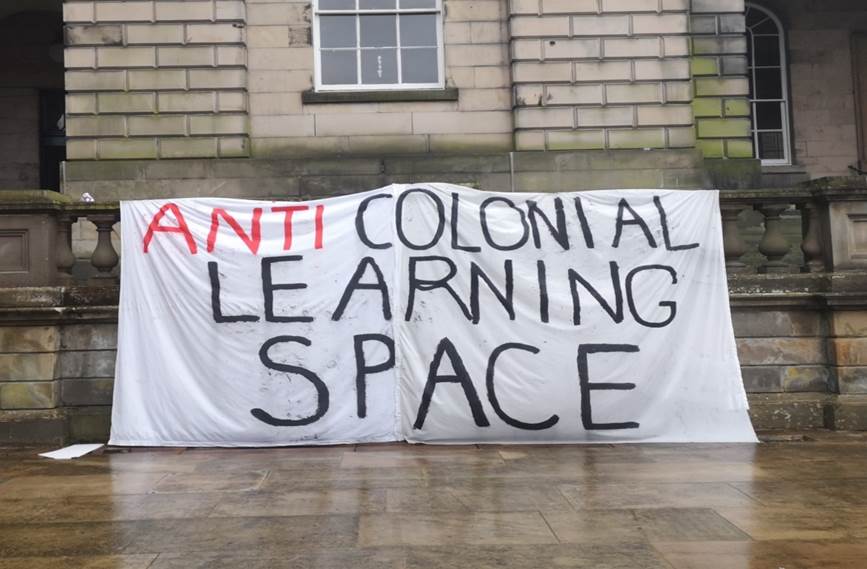
    To respond effectively to NRPF-related harms, engaging with Critical Race Theory (CRT), Black Feminism and Intersectionality provide foundational insights into the systemic nature of racism. These perspectives challenge colour-blind approaches and underscore the necessity of decolonising social work curricula.

    For example, CRT provides an analytic lens to examine how racism is embedded within society, including social work (Pajak, 2024). It challenges colour-evasive practices and calls for counter-storytelling that amplify the voices of those most affected. Applying CRT in NRPF contexts means recognising that immigration control is not race-neutral; it disproportionately impacts racialised individuals and communities and perpetuates structural inequality. Black Feminist thought compliments this approach by foregrounding the lived experiences of Black women, highlighting the interplay of race, gender, and power (Hill Collins, 1990).

    In particular, intersectionality (Crenshaw, 1989) offers a transformative lens for social work by highlighting how race, gender, class, immigration status, and other axes of identity intersect to shape oppression (Bernard, 2021; Nayak, 2022). For NRPF cases, intersectionality reveals how immigration restrictions compound racial discrimination, gendered violence, and poverty—issues often treated in isolation within mainstream practice. Lorde’s (1984) assertion that ‘the master’s tools will never dismantle the master’s house’ signals the limitations of reformist strategies within oppressive systems. Anti-racist practice requires rejecting dominant paradigms and embracing knowledge systems rooted in marginalised experiences.

    For social work, this necessitates pedagogical approaches that integrate activism, critical reflection, and praxis. Moreover, an intersectional lens critiques the profession’s historical and current complicity in racial oppression and calls for a validation of lived experience as knowledge. Intersectional paradigms not only illuminate structural inequalities but also inform strategies for resistance and transformation.

    Our research extends these concepts by interrogating whose knowledge counts and prioritises the voices of those with NRPF, who are navigating intersecting vulnerabilities, including precarious legal status, economic marginalization, and racial discrimination. By involving those with lived experience at every stage of our research, we are committed to ensuring that our research is collaborative. Our stakeholder group and Lived Experience Advisory Panel include women with lived experience of NRPF alongside practitioners from refugee and migrant support organisations.

    Alongside our quantitative survey, qualitative interviews will be essential to capture the emotional and practical lived realities behind statistical patterns. NRPF isn’t just a policy – it’s a lived reality shaped by race, gender, class, and immigration status and listening deeply to lived experience is a form of epistemic justice, valuing knowledge rooted in real life, not just theory. Ultimately, we need stories, voices, and perspectives that show the human cost of NRPF and the resilience of those navigating it.

    References

    Anka, A. (2024). Using the concept of epistemic injustice and cultural humility for understanding why and how social work curricular might be decolonized. Social Work Education43(9), 2880-2896.

    Bernard, C. (2021). Intersectionality for social workers: A practical introduction to theory and practice. Routledge.

    BlackDeer, A. A., & Ocampo, M. G. (2022). # SocialWorkSoWhite: A critical perspective on settler colonialism, white supremacy, and social justice in social work. Advances in Social Work22(2), 720-740.

    Citizens Advice. (2020) Citizens Advice reveals nearly 1.4m have no access to welfare safety net assessed from https://www.citizensadvice.org.uk/about-us/media-centre/press-releases/citizens-advice-reveals-nearly-14m-have-no-access-to-welfare-safety-net/

    Collins, P. H. (1990). Black feminist thought in the matrix of domination. Black feminist thought: Knowledge, consciousness, and the politics of empowerment138(1990), 221-238.

    Collins, P. H. (2022). Black feminist thought: Knowledge, consciousness, and the politics of empowerment. Routledge.

    Crenshaw, K. W. (1989). Demarginalizing the intersection of race and sex: A black feminist critique of antidiscrimination doctrine (pp. 139–168). In University of Chicago legal forum (Vol. 1).

    Garrett, P. M. (2024). What are we talking about when we are talking about ‘decolonising’ social work? The British Journal of Social Work54(5), 2027-2044.

    Ioakimidis, V., & Wyllie, A. (2023). Learning from the past to shape the future: uncovering social work’s histories of complicity and resistance. In Social Work’s Histories of Complicity and Resistance (pp. 3-28). Policy Press.

    Lorde, A. (1984). Sister outsider. Essay’s and Speeches by Audre Lorde. Freedom, CA: The Crossing Press.

    Minh-Ha, T. T. (2010). Elsewhere, within here: Immigration, refugeeism and the boundary event. Routledge.

    Nayak, S. (2022). An intersectional model of reflection: is social work fit for purpose in an intersectionally racist world?. Critical and Radical Social Work10(2), 319-334.

    Pajak, A. (2024). Critical Race Theory: Origins, Principles, Applications, and Evidence. Advances in Social Work24(3), 580-593.

    Probyn, E. (2003). The spatial imperative of subjectivity. Handbook of cultural geography, 290-299.

    Rosen, R., & Dickson, E. (2024). The exceptions to child exceptionalism: Racialised migrant ‘deservingness’ and the UK’s free school meal debates. Critical Social Policy44(2), 201-221.

    Tedam, P., & Cane, T. (2022). “We started talking about race and racism after George Floyd”: insights from research into practitioner preparedness for anti-racist social work practice in England. Critical and radical social work10(2), 260-279.

    Tusasiirwe, S. (2024). Disrupting colonisation in the social work classroom: Using the Obuntu/Ubuntu framework to decolonise the curriculum. Social Work Education43(8), 2170-2184.

    Woolley, A. (2019). Access denied: The cost of the ‘no recourse to public funds’ policy. London: Unity Project.
  • Andrea E Williamson and Calum Lindsay

    Illustrations by Jack Brougham.

    People who have ‘no recourse to public funds’ (NRPF) status in the UK are often invisible to public sector statutory services. Due to this citizenship status, they and their families do not have access to the care and safety nets that most of us take for granted. Healthcare access rights also vary across the four UK nations making a complex landscape even more so.

    People with NRPF who are in- or pushed out of-the asylum system; vulnerable migrants; are an important group who experience missingness in healthcare.

    Missingness is defined as the ‘repeated tendency not to take up offers of care such that it has a negative impact on the person and their life chances’(1).

    For decades there has been a focus on missed appointments more generally, however this has tended to focus on the impact of missed appointments at the service level such as cost to the NHS of missed appointments(2) rather than at the patient level, and makes no distinction between one off missed appointments and more enduring patterns(3). Our large-scale award winning research investigated patterns of missed appointments at the patient level in the general population for the first time. This was  in more than half a million Scottish general practice (GP) patient records.(4).

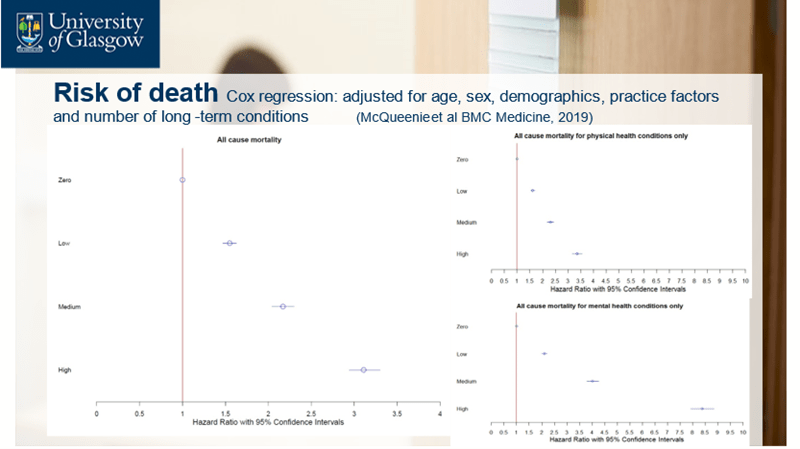
    We found that a high rate of missed GP appointments (an average of more than 2 per year) predicted very high premature death rates. Patients were more likely to have multi-morbidity (2 or more co-existing long term health issues), especially mental health conditions(5), and to experience high socio-economic disadvantage and other challenging social factors(4, 6).  Patients experienced high treatment burden – the work needed to manage their health – and missingness in use of acute hospital services too(7).

    These graphs(5) shows the chance of dying between the different patterns of missed appointments. If this stark difference in associated outcomes were for a health condition rather than health service utilisation patterns, there would be outrage.

    The data is either so poor, or not available for linkage, to be able to know how many people in this epidemiological research were in the asylum system or who experience NRPF. The existing research was sparse also on why people may be missing from healthcare and what could be done to address it. It also tended to problematise the issue as being the fault of patients and an issue for services, rather than the fault of services, and an issue for patients.  It was also viewed as being  about single issues, hence tended to come up with ‘one size fits all’, reductive solutions(3).

     So in our latest research we used realist methods to create a theory about the causes of missingness and to determine what might work, for whom, and under what circumstances, to address these causes. This was a review of 197 published papers(3), interviews with 61people, stakeholder workshops with 16 people to review our results, and further review of the literature to develop our suite of interventions. Our participants were health and care professionals and people with lived experience of missingness from a range of clinical, social and inclusion health contexts. This included vulnerable migrants who have families.

     We found that causes of multiple missed appointments occurred across the patient journey and are driven by complex interactions between patients’ circumstances and the ways in which services are designed and delivered.

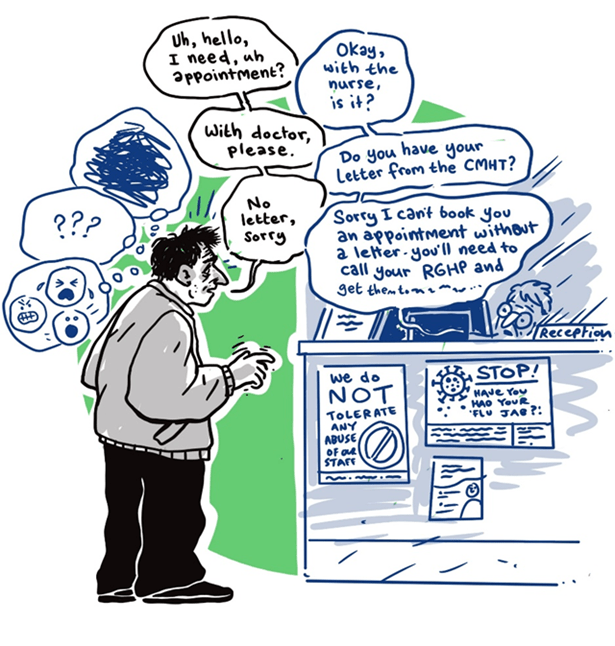
    Patients may feel that the service is not for them – not needed, not able to improve their health, not appropriate, or is unsafe. This may be influenced by past experiences of mistreatment, conflicting understandings of health, poor communication, and offers of care in the NHS that do not ‘fit.’

    “There’s a constant dynamic of conflict […] and this is a theme you’ll find from anybody you speak to, who has a child or an adult with complex health needs, a constant fight.  And some people; they get exhausted, and they give up, and I can’t blame them.” (Jodie, Glasgow)

    Some may experience issues physically getting to appointments because of travel costs and difficulties, poor health impeding mobility, and concerns about safety. NHS services have often specific, inflexible rules for how they are used, making it hard for patients to arrange the right appointment for them – at the right time, by the right method, with the right person.

    ‘Missing’ patients may be subject to a host of competing demands with limited resources to manage or meet them, including work, other appointments, caring responsibilities, or urgent and pressing needs or crises caused by precarious circumstances.

    It’s all very much about the now, where you’re going next. How you’re going to make a living. […] Is it ‘go to the appointment’, or ‘I’ve just been offered this job, which is going to give me a couple of hundred quid in the pocket, which is going to make a difference.” (Naomi, Brighton)

    Finally, a lifetime’s worth of experiences of stigma, hostility, trauma, and difficult relationships with care may act as a deterrent against accessing care. 

    Our suite of interventions developed along with our professionals and experts by experience of missingness is under review for publication. This is aimed at changing the way care is delivered for everyone who is missing from healthcare.  A key aspect of this involves changing the attitudes of NHS staff and the wider public – ‘applying and then embedding a missingness lens to health care’. This, along with additional resource for the NHS, will create the conditions to make widespread change.

    Tangible positive experiences of healthcare, able to adapt to everyone’s circumstances is required to start closing the health equity gap and realise our ambitions of a healthcare system rooted in human rights. For vulnerable migrants who experience NRPF however, the role of structural barriers in creating and perpetrating missingness(8)  is writ so much larger than for any other group. So this NIHR funded research about health outcomes for children and families who experience NRPF with or without section 17 support in England  is so vital.

    References

    1.Lindsay C, Baruffati D, Mackenzie M, Ellis D, Major M, O’Donnell K, et al. A realist review of the causes of, and current interventions to address ?missingness? in health care. [version 1; peer review: awaiting peer review]. NIHR Open Research. 2023;3(33).

    2.England N. Missed GP appointments costing NHS millions. UK: NHS England; 2019.

    3.Lindsay C, Baruffati D, Mackenzie M, Ellis DA, Major M, O’Donnell CA, et al. Understanding the causes of missingness in primary care: a realist review. BMC Medicine. 2024;22(1):235.

    4.Williamson AE, Ellis DA, Wilson P, McQueenie R, McConnachie A. Understanding repeated non-attendance in health services: a pilot analysis of administrative data and full study protocol for a national retrospective cohort. BMJ Open. 2017;7.

    5.McQueenie R, Ellis DA, McConnachie A, Wilson P, Williamson AE. Morbidity, mortality and missed appointments in healthcare: a national retrospective data linkage study. BMC Medicine. 2019;17(1):2.

    6.Williamson AE, McQueenie R, Ellis DA, McConnachie A, Wilson P. General practice recording of adverse childhood experiences: a retrospective cohort study of GP records. BJGP Open. 2020:bjgpopen20X101011.

    7.Williamson AE, McQueenie R, Ellis DA, McConnachie A, Wilson P. ‘Missingness’ in health care: Associations between hospital utilization and missed appointments in general practice. A retrospective cohort study. PLOS ONE. 2021;16(6):e0253163.

    8.Mackenzie M, Baruffati D, Lindsay C, O’Donnell K, Ellis D, Simpson S, et al. Fundamental causation and candidacy: Harnessing explanatory frames to better understand how structural determinants of health inequalities shape disengagement from primary healthcare. Social Science & Medicine. 2025;374:118043.


  • David Stark, Research Fellow, University of Birmingham

    We were interested last week to read the Children’s Commissioner’s report on Growing Up in Poverty, which highlights the ‘Dickensian’ levels of poverty experienced by 1 million destitute children presently living in the UK. The report makes salient observations on the impacts of poverty on children’s and young people’s lives, and the relationship between the welfare benefits system and child poverty.

    Strikingly, from our perspective, however, there is but one reference within the report to the experiences of children in families denied recourse to public funds, and so unable even to access the welfare benefits under consideration.

    This is, in a sense, unsurprising. While it is estimated that around 722,000 children across the UK are subject to the NRPF condition, and that 382,000 of these children are living in poverty, little firm data exists about these children, and no statutory authority presently has the responsibility for collating any such data. Similarly. while section 17 of the 1989 Children Act confers responsibility for the accommodation and financial support of these children to safeguard and promote their welfare, there is marked inequality both in terms of access to and delivery of this support from local authority to local authority.

    Freedom of Information data obtained earlier this year by the UoB NRPF project on which I am working highlights this. While we have established that over 3000 children in 1800 families in England are presently supported under section 17, forty-one of the 151 (27%) local authorities in England told us that they had no way at all of identifying whether or not they were actually supporting children and families with no recourse, while 116 (77%) of these told us they were unable to identify how many families had requested an assessment of need but subsequently been denied support provision.. 9 authorities (6%) claimed to be supporting no such families at all. Thousands of children and families across the country are, in other words, to all intents and purposes invisible to statutory support providers.

    While the High Court has determined that it is unlawful for local authorities to provide financial support for children cared for by foreign national carers with the right to remain in the UK at the same ‘subsistence’ levels made available under certain circumstances to children cared for by foreign nationals without the right to remain FOI data suggests that only 13 (9%) of local authorities are paying any regard to this distinction, with 138 ((92%) only acknowledging a duty to provide subsistence level support to prevent destitution, commensurate with Home Office asylum support levels. Indeed, several authorities volunteered that their support provision is significantly lower even than the Home Office’s £49.18 weekly allowance, with sums as low as £39.79 per person per week recorded.

    We know that three quarters of children with no recourse either already are, or are soon likely to become British citizens. The presenting situation, then, is one in which thousands of long-term residents are being kept in conditions of deep poverty as a consequence of their parents’ or cares’ immigration statuses, while little or no information is being recorded about their experiences, and support provision designed to keep them from literal destitution is scattershot and inconsistent.

    From the general direction of social policy travel, it is evident that this situation is unlikely to change any time soon. The Government has recently published its White Paper on immigration, setting out its determination to make both citizenship and settlement harder to come by, thus increasing the number of families subject to the NRPF condition, while the Leader of the Opposition, fuelled by a media discourse focused intently on the nexus between immigration control and welfare benefits reform, is calling for a complete ban on access to sickness and disability benefits for non-UK nationals. .Reform UK, currently high in the opinion polls and looking almost certain at the very least to play a part in the formation of the next government, has made the question of immigration ‘control’ a totemic policy issue and, again, has pledged to severely restrict migrants’ access to welfare benefits, with the party widely regarded as the most influential force in contemporary British political life.

    Following political pressure from Reform-adjacent figures, the Department for Work and Pensions has today, for the first time, published data on the nationality and immigration status of Universal Credit claimants. Despite these figures detailing that 83.6%of applicants are UK or Irish nationals, and that just 1% are ‘temporary’ migrants, the data has, predictably, led to further calls for restrictions to migrants’ access to public funds.

    There could scarcely be a more timely moment, then, to think about the long-term impact of curtailed access to the welfare safety net on the health and development of children and young people.

    This is why our team is hoping to recruit people with lived experience of living with no recourse to who will agree to be a part of our project over the next 24 months.. We will be asking people to complete an online questionnaire, asking questions about their children’s health and wellbeing, once every 6 months. We will also be looking to hold more detailed in person conversations with a smaller number of people to discuss matters of particular significance.. We hope to start this work as soon as possible.

    We are happy to complete questionnaires over the telephone if people are struggling with internet access, and we plan to travel to carry out the in-person interviews, to minimise any personal or financial inconvenience, but if you have any queries at all around data, travel or any other costs, please contact us. We absolutely do not want anyone to be left out of pocket by helping us with this project.

    Ideally, of course, we are hoping that people will be able to commit to joining us on the project for the full 3 years, but we do understand that circumstances change and life can be complicated, so we respect that people have the right to withdraw their consent and leave the project at any time. We understand that confidentiality is important, and so we will be making sure that people who participate in the project remain anonymous, and cannot be identified personally.

    If you are interested, or if you would like any further information, please contact me at d.r.stark@bham.ac.uk

  • No Recourse to Public Funds: a driver of child health inequalities?

    The question of immigration has occupied significant space in policy discourse over recent years, with successive administrations effectively staking electoral fortunes on their determination to ‘stop the boats’, and ‘take back control’ of the nation’s borders. The issue is invariably framed in terms of crisis and overload, with a series of punitive measures put in place to design a ‘hostile’ or ‘compliant’ environment, policy responses explicitly designed to make life in the UK as difficult as possible for people without settled immigration status- and, therefore, by implication, to encourage them to leave.

    One of these ‘hostile environment’ measures is the No Recourse to Public Funds (NRPF) condition, a provision within the Immigration Rules which prevents most temporary migrants to the UK from accessing a range of welfare benefits and social housing provision. The rationale for this measure is set out in Nationality Immigration and Asylum Act (NIAA) 2002: “It is in the public interest, and in particular in the interest of the economic well-being of the United Kingdom, that persons who seek to enter or remain in the United Kingdom are financially independent, because such persons (a) are not a burden on taxpayers, and (b) are better able to integrate into society.”

    Perhaps remarkably, there is evidence to suggest that many legislators do not, themselves, understand the full implications of these measures, with the then Prime Minister, Boris Johnson, incredulously asking a Parliamentary colleague, during the period of the Covid-19 pandemic lockdown, why a constituent family of his, denied recourse, could not simply claim Universal Credit to prevent their descent into destitution[   That said, it is an accepted fact that many families with NRPF who are living in poverty, without a safety net or access to much of the social security system, face tough circumstances, and that these circumstances can be particularly challenging for children.

    There is a clear tension, then, between the electoral imperative to look ‘tough’ on immigration and to make life as difficult and impoverished as possible for people subject to immigration control, and the abundance of research evidence suggesting that child health inequalities are exacerbated by child poverty. In other words, the question could reasonably asked whether children are in fact ‘better able to integrate into society’, as the NIAA puts it, if they are experiencing financial hardship.

    One of the few statutory support provisions available to families facing destitution because of their NRPF status is under section 17 of the Children Act 1989, which places a duty on local authorities in England to safeguard and promote the welfare of children in need- potentially including the provision of accommodation and financial support if deemed necessary to meet an assessed need. While successive court judgements dating back over the years have upheld the principle that section 17 provision cannot reasonably be denied to eligible migrant families in need, provision across the country remains patchy and inconsistent, with gatekeeping measures, expressly designed to deny access, endemic.

    From a local authority perspective this is perhaps unsurprising. If children and families subject to immigration control are denied  access to mainstream welfare benefits paid by the Department of  Work and Pensions (DWP), but remain potentially eligible for the provision of financial support from local authority children’s services budgets, then what has essentially happened is that financial responsibility for these children and families has simply been reallocated from national to local government- while austerity measures and central government cuts have severely curtailed local government budgets. Local authorities receive no financial dispensation from central government for these costs, which can be consequential for ‘superdiverse’ urban administrations with significant migrant populations.  In the decade between 2010 and 2020, for example, Birmingham City Council’s spending power reduced by 36.3%, and the authority, like several others around the UK, has effectively declared itself insolvent.

    Small wonder, then, if some local authority children’s services teams are predisposed to refuse approaches for financial support irrespective of any legal duties.

    While the existence of the problem, then, is well established, there is surprisingly little hard data on its scale. The Home Office has faced criticism for its inability to provide reliable statistics on the scale or the effects of the NRPF policy. Estimates, however, suggest that, as of 2019, around 175,000 children were living in households denied recourse.  More, there is little or no information available on the  long-term impacts on child health and development of living without recourse to the basic welfare safety net, or of the provision- or, indeed, the denial- of section 17 Children Act support to those children and young people.

    With that in mind, a multi-disciplnary team of researchers from the University of Glasgow, Glasgow Caledonian University, and Kings College, London, led by the University of Birmingham’s School of Social Policy and Society,  has secured funding from the National Institute of Health and Care Research to conduct a study of the longitudinal impacts of the denial of recourse to public funds on the health and wellbeing of children and families in the UK. Over the next three years, we will be working with partners from across the UK to identify and engage with participant families from across the nine English regions to explore the impacts of the denial of recourse, the differing health and developmental outcomes for families in need who have access to section 17 support and those who do not, and the good practice implications which can help bring about improved outcomes